
Specialty roofing · Copper
Copper details should solve the transition beautifully.
Copper roofing requires an appreciation for thermal movement, precise geometry, and the natural development of patina over decades. Our approach to architectural metal focuses on understanding how these assemblies interact with surrounding masonry and structure, ensuring that interventions respect the original detailing while restoring reliable performance.
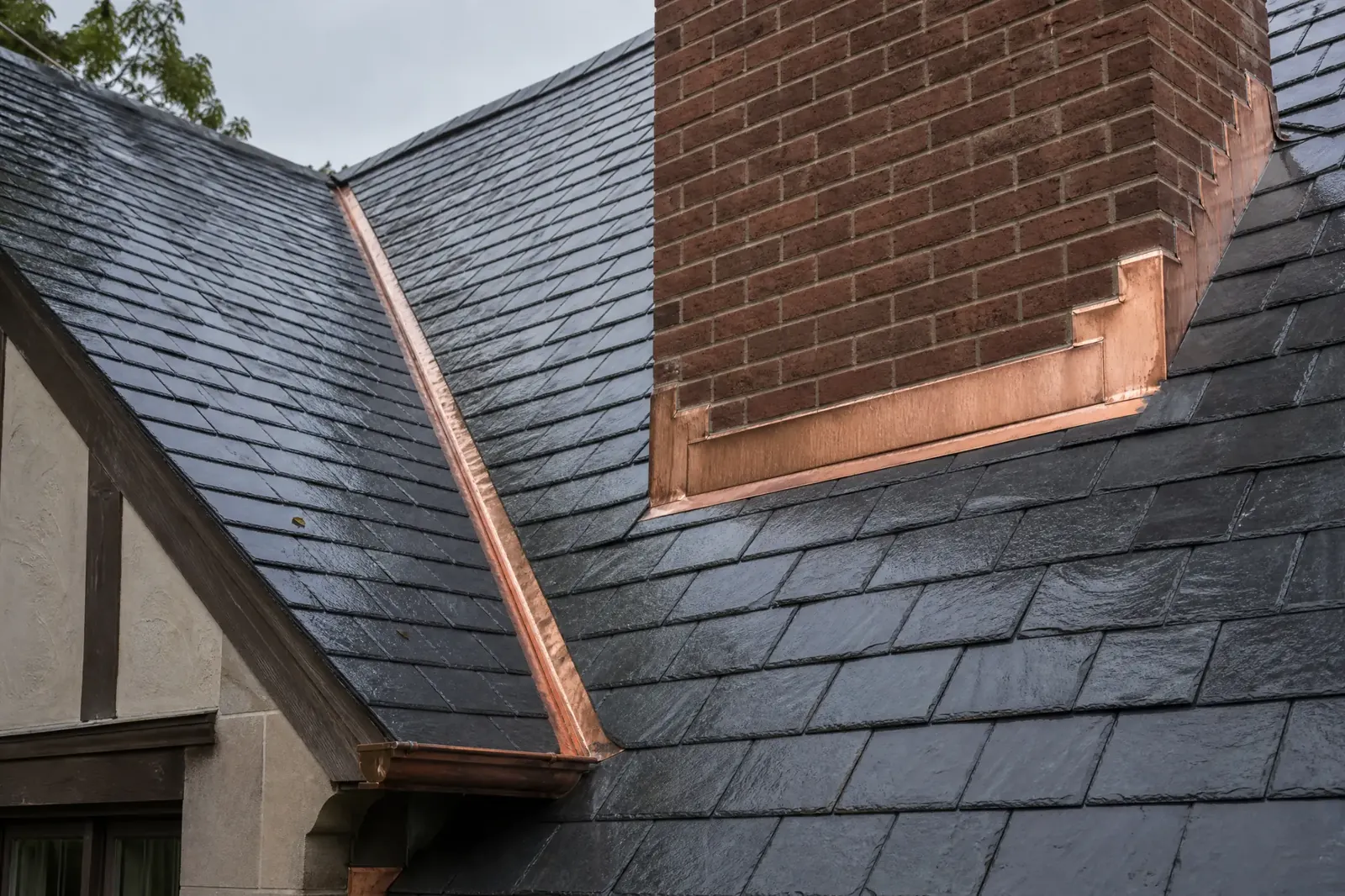
We prioritize targeted repairs of failed seams and flashing before recommending complete replacement, preserving the established patina and historical character wherever structurally viable.
The material changes the method.
Thermal Movement and Patina Development in Copper
Specialty roofing is evaluated through the interaction of individual units or metal fields, fastening, flashing, geometry, substrate, access, and water movement.
Thermal Expansion
Copper expands and contracts significantly with temperature changes, requiring carefully designed seams and expansion joints to prevent buckling, metal fatigue, and eventual failure at fixed points.
Patina Formation
The natural oxidation process creates a protective patina that evolves from bright copper to deep brown and eventually green, providing exceptional corrosion resistance and distinct architectural character.
Masonry Interfaces
Where copper meets brick or stone, the flashing must accommodate differential movement while preventing water intrusion, often requiring specialized reglets and careful integration with the masonry joints.
Galvanic Corrosion
Copper must be isolated from incompatible metals like aluminum or galvanized steel to prevent rapid galvanic corrosion, dictating careful selection of fasteners, adjacent flashing, and drainage components.
Observe the field. Trace the transition.
Assessing Copper Seams, Flashing, and Structural Integrity
Access limits, delicate materials, hidden layers, steep geometry, and occupied properties are included in the assessment plan rather than treated as afterthoughts.
Seam Evaluation
We examine standing seams and flat lock joints for signs of stress, separation, or fatigue cracking caused by restricted thermal movement over time.
Flashing Integration
The assessment includes a careful review of step flashing, counterflashing, and valley linings to identify areas where water may bypass the metal envelope.
Fastener Conditions
We inspect concealed cleats and exposed fasteners to ensure they remain secure and are not contributing to localized galvanic corrosion or mechanical failure.
Solder Joint Integrity
Older soldered connections are evaluated for stress fractures or deterioration, which often occur at complex transitions, corners, and built-in gutter linings.
Substrate Stability
The underlying decking is checked for moisture damage or deflection, as a stable, smooth substrate is critical for the long-term performance of copper roofing.
Responsible intervention
Planning for Copper Repair and Responsible Replacement
Copper repair planning begins with the existing metal, seam geometry, movement, substrate, and surrounding materials. When localized work is feasible, the goal is compatible integration that restores the transition without unnecessarily disturbing sound adjacent sections.
When the metal has thinned beyond repair or widespread fatigue compromises the system, responsible replacement becomes necessary. We plan these transitions carefully, ensuring that new copper assemblies are detailed to accommodate modern structural realities while respecting the historical geometry and scale of the original architectural design.
Preserve what performs. Correct what fails.
These answers frame the decision. The condition of the actual roof determines which option remains responsible.
Schedule a Consultation for Your Copper Roofing System
Contact us to discuss the condition of your architectural copper. We provide careful assessments and thoughtful guidance on repair, preservation, and replacement strategies tailored to your specific building.