
Specialty roofing
Distinctive roofs require material-specific judgment.
Specialty roofing demands a fundamental shift in perspective. Rather than viewing a roof as a disposable surface, we approach slate, tile, and copper as enduring architectural systems. The interaction between rigid materials, complex geometry, and custom flashing requires deliberate assessment. Our focus remains on understanding material behavior to guide responsible preservation, targeted repair, or necessary replacement.
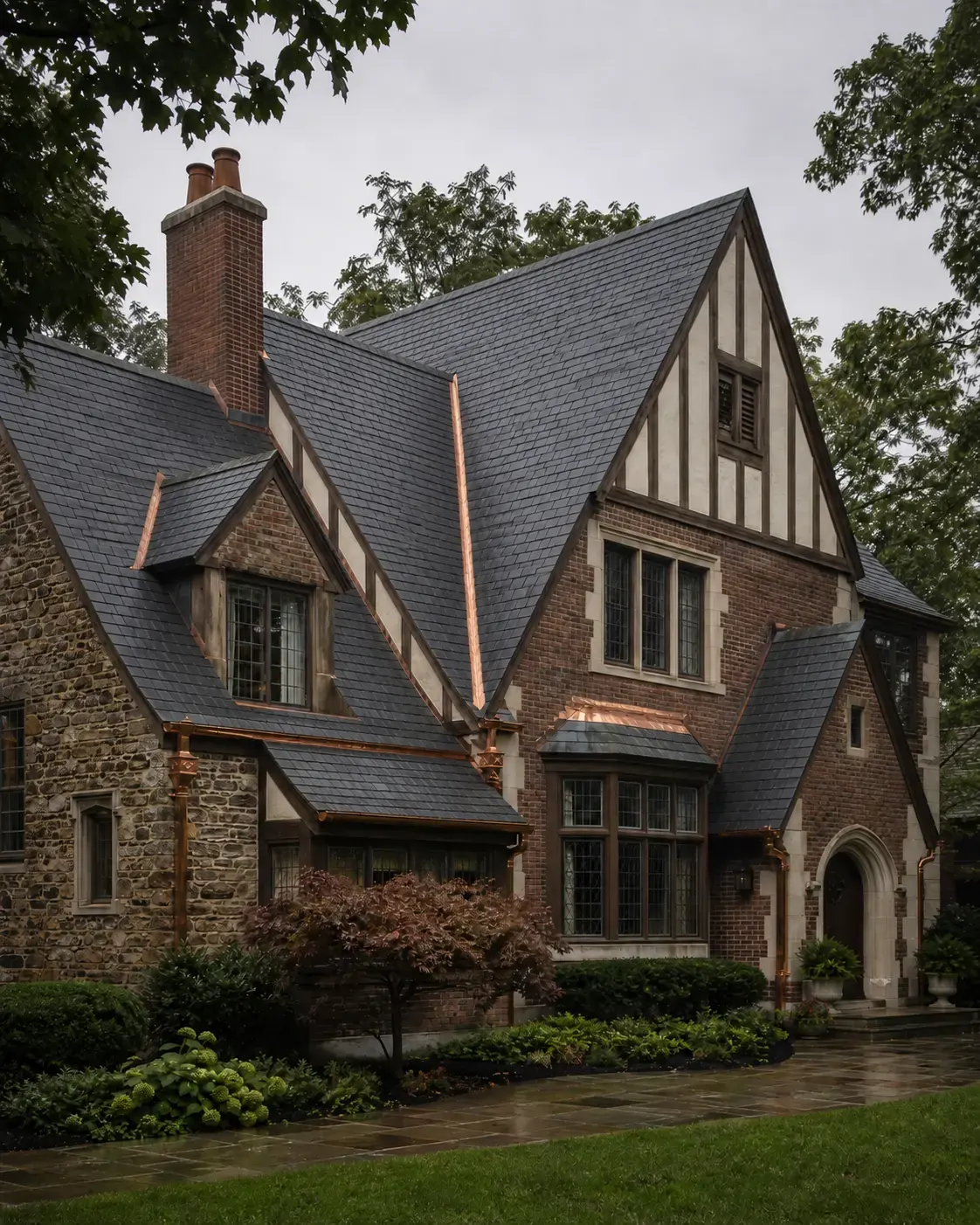
We prioritize targeted repairs over premature replacement, intervening only when material degradation or systemic failure compromises the building envelope.
The material changes the method.
Understanding the behavior of traditional roofing materials
Specialty roofing is evaluated through the interaction of individual units or metal fields, fastening, flashing, geometry, substrate, access, and water movement.
Slate Systems
Natural stone requires careful evaluation of cleavage planes and mineral content. We assess the condition of individual slates alongside the integrity of underlying fasteners and structural decking.
Clay and Concrete Tile
The weight and interlocking geometry of tile systems demand precise alignment. We focus on identifying thermal expansion issues, mortar deterioration, and the performance of critical underlayment layers.
Architectural Copper
Copper roofing relies on accommodating natural thermal movement. Our evaluation centers on soldered joints, expansion cleats, and the development of the protective patina that ensures long-term weather resistance.
Historic Assemblies
Older structures often feature irregular framing and obsolete fastening methods. We analyze how modern interventions will interact with original materials to maintain proper ventilation and structural balance.
Observe the field. Trace the transition.
Comprehensive assessment of specialty roofing systems
Access limits, delicate materials, hidden layers, steep geometry, and occupied properties are included in the assessment plan rather than treated as afterthoughts.
Material Degradation
We examine the physical state of the primary roofing material, looking for signs of delamination, spalling, or metal fatigue that indicate the end of a functional lifespan.
Flashing Integrity
Complex intersections are the most vulnerable points. We inspect valley linings, step flashing, and chimney saddles for galvanic corrosion, mechanical damage, or sealant failure.
Fastener Condition
The method of attachment often fails before the roofing material itself. We evaluate the condition of copper nails, wire ties, and clips for signs of systemic corrosion.
Structural Deflection
Heavy materials like slate and tile require robust support. We look for sagging rafters or compromised decking that could disrupt the precise layout of rigid roofing units.
Access Constraints
Specialty roofs often involve steep pitches and delicate surfaces. We determine the safest methods for staging and movement to prevent collateral damage during the inspection process.
Responsible intervention
Developing a responsible strategy for repair or replacement
Effective planning begins with distinguishing between isolated damage and systemic failure. When a specialty roof exhibits localized issues, such as slipped slates or cracked tiles, targeted repairs can often restore the system's integrity without disturbing the surrounding materials. This approach respects the original architecture while managing resources efficiently.
However, when underlying components like fasteners or underlayment have reached the end of their service life, a broader intervention becomes necessary. In these cases, we develop a comprehensive replacement strategy that addresses structural requirements, modern ventilation standards, and the precise detailing required to replicate the original aesthetic.
Preserve what performs. Correct what fails.
These answers frame the decision. The condition of the actual roof determines which option remains responsible.
Schedule a detailed assessment of your specialty roofing system
Contact us to arrange a comprehensive evaluation of your slate, tile, or copper roof. We provide clear, objective insights into the condition of your materials and develop responsible strategies for long-term preservation.