
Core roofing · Active leaks
A roof leak needs a source, not a guess.
Water intrusion rarely follows a direct path from the exterior envelope to the interior ceiling. Identifying the true origin of a leak requires methodical observation of roof planes, masonry intersections, and attic spaces. By tracing moisture patterns back to their source, we can diagnose underlying vulnerabilities and recommend targeted corrective work rather than superficial patches.
Effective leak resolution prioritizes identifying the exact point of failure to determine whether localized repair or broader component replacement is the most responsible intervention.
Tracing water entry to its architectural source.
Observing Common Symptoms of Water Intrusion
Visible symptoms establish where the investigation begins. They do not, by themselves, define the responsible repair or replacement scope.
Ceiling Discoloration
Brown or yellow stains on interior ceilings often indicate water pooling above the drywall, suggesting a slow, persistent leak that has traveled along rafters or joists before manifesting indoors.
Masonry Efflorescence
White, powdery deposits on chimney brickwork or parapet walls point to moisture moving through the masonry, which can compromise adjacent flashing systems and allow water to bypass the roof covering.
Attic Condensation
Excessive moisture or frost accumulation on the underside of roof decking typically signals inadequate ventilation, which can mimic a leak by allowing trapped humidity to condense and drip onto insulation.
Valley Debris Accumulation
Leaves and branches trapped in roof valleys obstruct natural water flow, forcing runoff to back up under shingles or underlayment during heavy rain, leading to localized saturation and eventual ingress.
Assessment before assumption.
Tracing the Path of Moisture Through the Envelope
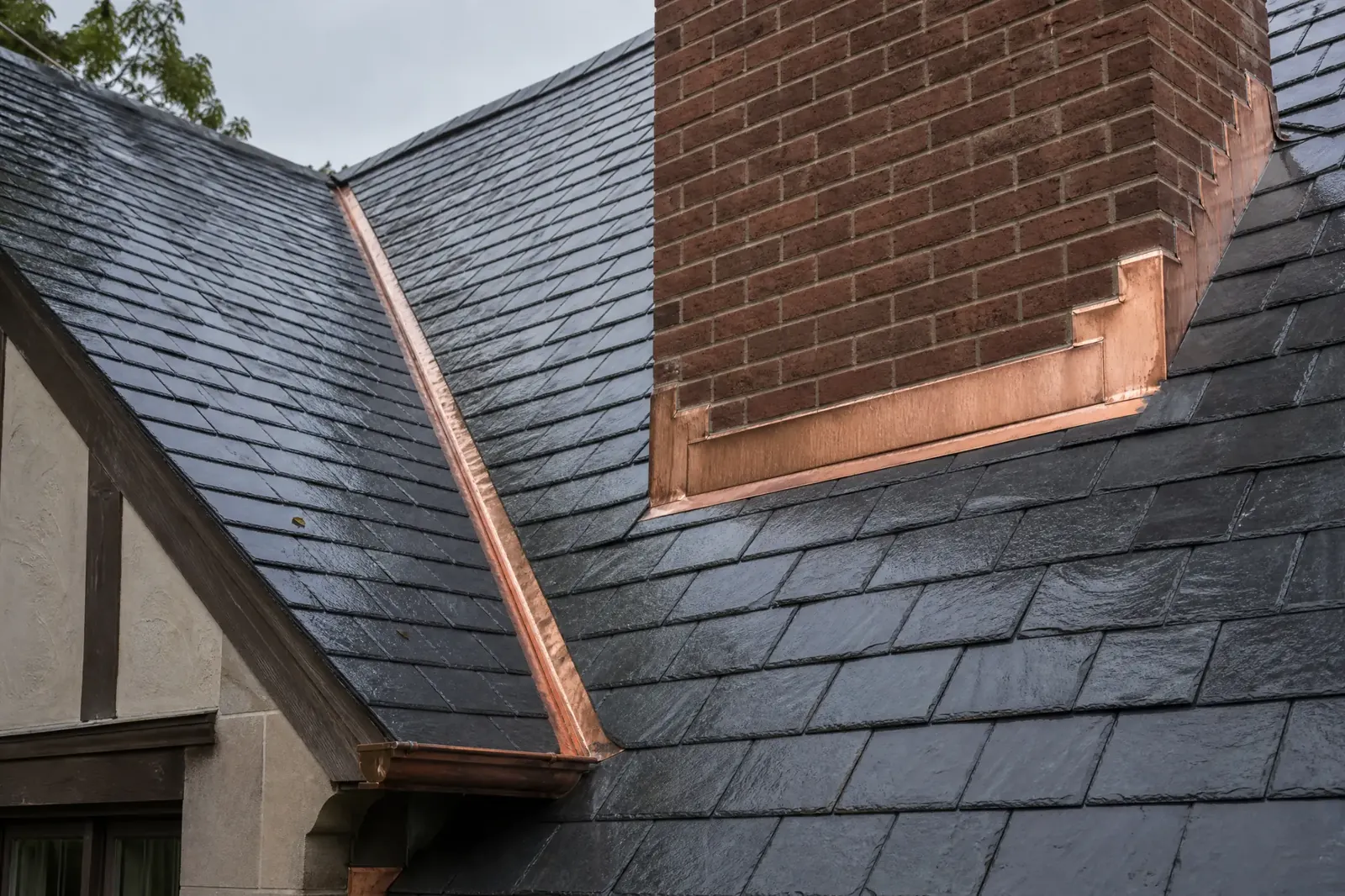
Flashing Inspection
We examine step flashing, counterflashing, and vent boots for separation, corrosion, or sealant failure, as these transitions are frequent points of water entry.
Decking Evaluation
Probing the roof deck from within the attic space helps identify soft spots, delamination, or rot that indicate prolonged moisture exposure beneath the primary roofing material.
Shingle Integrity
Assessing the condition of individual shingles reveals whether wind uplift, thermal cracking, or granular loss has compromised the overlapping barrier designed to shed water effectively.
Penetration Sealing
All roof penetrations, including plumbing vents and skylights, are scrutinized to ensure that integrated flashing components remain securely integrated with the surrounding roof plane.
Drainage Analysis
We observe how water moves across the roof surface and through gutter systems to identify blockages or pitch issues that contribute to standing water and subsequent leakage.
When a leak is traced to an isolated defect, such as a damaged pipe boot or a single missing shingle, temporary or localized repairs can effectively restore the watertight integrity of the roof plane. This targeted approach addresses the immediate symptom without requiring extensive disruption to the surrounding architectural components.
However, if the assessment reveals systemic failure, such as widespread underlayment degradation or compromised flashing across multiple intersections, durable corrective work may necessitate partial or complete replacement of the affected sections. Recommending the appropriate scope ensures that the underlying vulnerability is resolved, preventing recurrent moisture intrusion and preserving the structure.
Answers connected to this roof condition.
General guidance helps frame the assessment. The recommendation still depends on the materials, transitions, access and evidence at the property.
Schedule a Methodical Roof Leak Assessment
Addressing water intrusion promptly prevents progressive structural degradation. Contact us to arrange a detailed evaluation of your roof system, where we will trace the source of the leak and recommend the most appropriate corrective measures for your property.