
Specialty roofing · Preservation
Historic roof work begins with what should be preserved.
Historic roof restoration requires a measured approach that balances architectural sensitivity with modern water management. We evaluate original materials, intricate geometries, and complex flashing systems to determine the most responsible path forward. Our focus remains on retaining historic fabric where viable, while recognizing when thoughtful replacement becomes necessary to protect the structure.
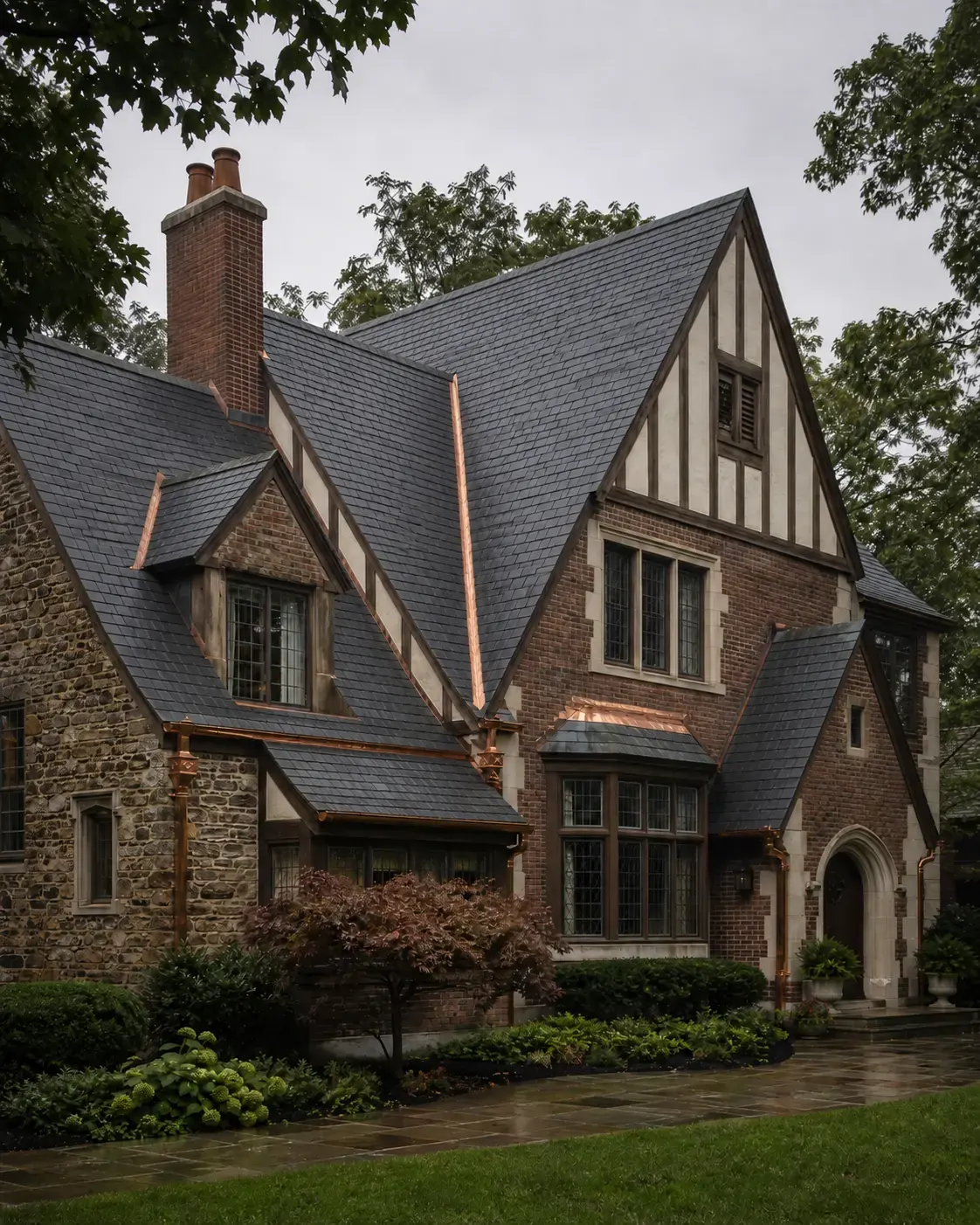
We prioritize repair over replacement, aiming to retain original materials whenever structurally sound, while ensuring the building envelope remains fully protected against water intrusion.
The material changes the method.
Understanding the Behavior of Traditional Roofing Materials
Specialty roofing is evaluated through the interaction of individual units or metal fields, fastening, flashing, geometry, substrate, access, and water movement.
Slate and Tile
These dense materials offer exceptional longevity but require careful handling. We assess individual units for delamination or cracking, focusing on targeted replacement rather than wholesale removal.
Copper and Metal
Historic metalwork expands and contracts with temperature shifts. We evaluate the condition of seams, solder joints, and fasteners to ensure thermal movement remains unhindered while maintaining watertight integrity.
Existing Metalwork
Valleys, flashings, roof sections, gutters, and other architectural metal are evaluated for movement, seam fatigue, corrosion, and their relationship to masonry and roofing materials.
Custom Flashing
Complex roof geometries often feature intricate flashing details. We study these original transitions to understand their water management function, replicating their profiles to maintain both historical accuracy and performance.
Observe the field. Trace the transition.
Comprehensive Assessment of Historic Roof Systems
Access limits, delicate materials, hidden layers, steep geometry, and occupied properties are included in the assessment plan rather than treated as afterthoughts.
Material Condition
We meticulously examine the existing roofing fabric to identify areas of deterioration, assessing whether the original materials can be salvaged or require careful matching.
Structural Substrate
The underlying decking and framing are evaluated for moisture damage or deflection, ensuring the structure can continue to support the weight of traditional materials.
Flashing Integrity
We inspect all valleys, chimneys, and parapet walls, as these critical transitions are often the primary source of water intrusion in older, complex roof designs.
Drainage Pathways
Historic water management systems are analyzed to confirm that gutters, scuppers, and downspouts are adequately sized and functioning correctly to direct water away from the building.
Access Planning
We determine the safest and least intrusive methods for accessing the roof, minimizing potential impact on the surrounding property and the historic structure itself.
Responsible intervention
Developing a Responsible Restoration Strategy
A successful historic restoration requires a phased approach that respects the original architecture. We begin by documenting existing conditions and identifying the specific materials and techniques used during the initial construction. This careful study informs our methodology, allowing us to design interventions that address current vulnerabilities while preserving the visual character of the roofline.
When original materials cannot perform responsibly, the plan should identify compatible replacement options, preserve sound adjacent work, and document how new components will manage water and relate to the building's existing geometry. Review requirements are incorporated when they apply to the property and proposed scope.
Preserve what performs. Correct what fails.
These answers frame the decision. The condition of the actual roof determines which option remains responsible.
Discuss Your Historic Roof Restoration Requirements With Us
Reach out to explore thoughtful preservation strategies for your property. We provide careful assessments and develop responsible restoration plans tailored to the unique architectural demands of your historic roof.